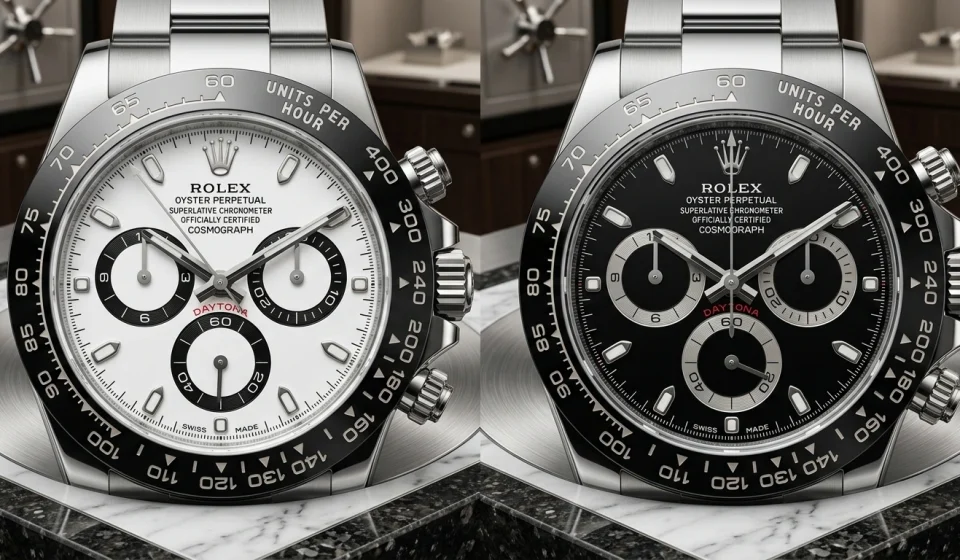

In the modern luxury watch landscape, Rolex continues to represent the benchmark for precision engineering, design consistency, and long-term value retention. As we move through 2026, the conversation around high-end superclone Rolex watches has become more prominent among collectors and enthusiasts.
These superclones are advanced replicas designed to closely replicate genuine Rolex models using improved materials, upgraded movements, and refined finishing techniques. While they can look highly convincing in daily use, they remain non-authentic products with no official Rolex certification, warranty, or service support.
This article provides a structured side-by-side comparison between genuine Rolex watches and high-end superclones, focusing on real-world differences in materials, construction, movement behavior, and finishing quality.
The goal is to highlight observable distinctions rather than subjective opinions, helping readers understand where modern replicas have improved—and where clear differences still remain.
What Are Superclone Rolex Watches?
Superclones represent the highest tier of replica watches currently available. In 2026, leading factories such as VS Factory and Clean Factory produce models using upgraded stainless steel equivalents, sapphire crystals, ceramic bezel inserts, and cloned automatic movements.
Despite their visual similarity to genuine Rolex watches, superclones are not authentic timepieces. They do not include COSC certification, in-house Rolex calibers, or official service infrastructure.
Their appeal lies mainly in appearance, wrist presence, and affordability compared with genuine Rolex models.
Methodology of Comparison
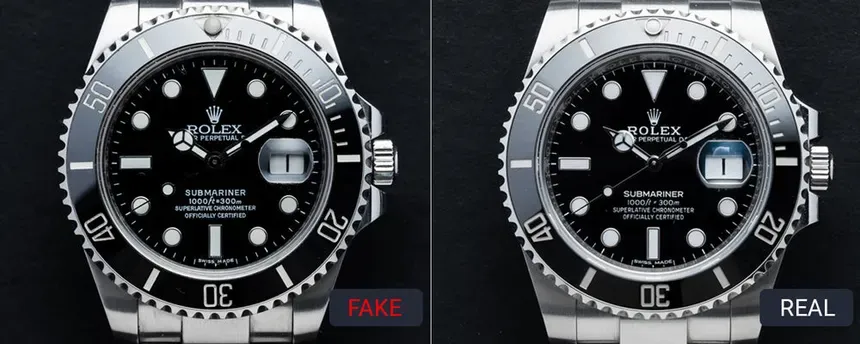
This comparison is based on visual inspection, functional testing, and technical evaluation across multiple Rolex models. Key factors include case finishing, dial printing, crystal clarity, bracelet construction, movement behavior, and weight distribution.
Observations are made under controlled lighting conditions using magnification tools where necessary to identify fine differences.
While superclones can appear highly convincing at arm’s length, closer inspection reveals structural and mechanical distinctions.
Overall Side-by-Side Comparison
| Category | Genuine Rolex | Superclone (2026 High Tier) | Key Differences |
|---|---|---|---|
| Case Material | 904L Oystersteel | 904L-equivalent steel | Genuine holds polish longer |
| Bezel Action | Precise 120-click system | Close imitation, slightly softer feel | Click consistency differs |
| Dial Printing | Perfect alignment & laser precision | High-quality, minor spacing variations | Subtle font inconsistencies |
| Crystal & Cyclops | Exact magnification & clarity | Slight distortion or misalignment in some batches | Date magnification varies |
| Movement | In-house Rolex calibers | Cloned movements (VS/4130/3235 types) | Regulation precision gap |
| Weight & Balance | Factory-precise distribution | 5–15g variance possible | Detectable under scale |
| Engravings | Deep, sharp, perfectly aligned | Shallower or slightly inconsistent | Rehaut clarity differs |
| Bracelet & Clasp | Tight tolerances, refined finish | Slightly softer engraving & edges | Fit refinement gap |
| Lume Performance | Long-lasting Chromalight | Strong initial glow, faster fade | Duration inconsistency |
| Service & Warranty | Global official support | Third-party only | Long-term value difference |
Model Breakdown: Key Rolex Comparisons
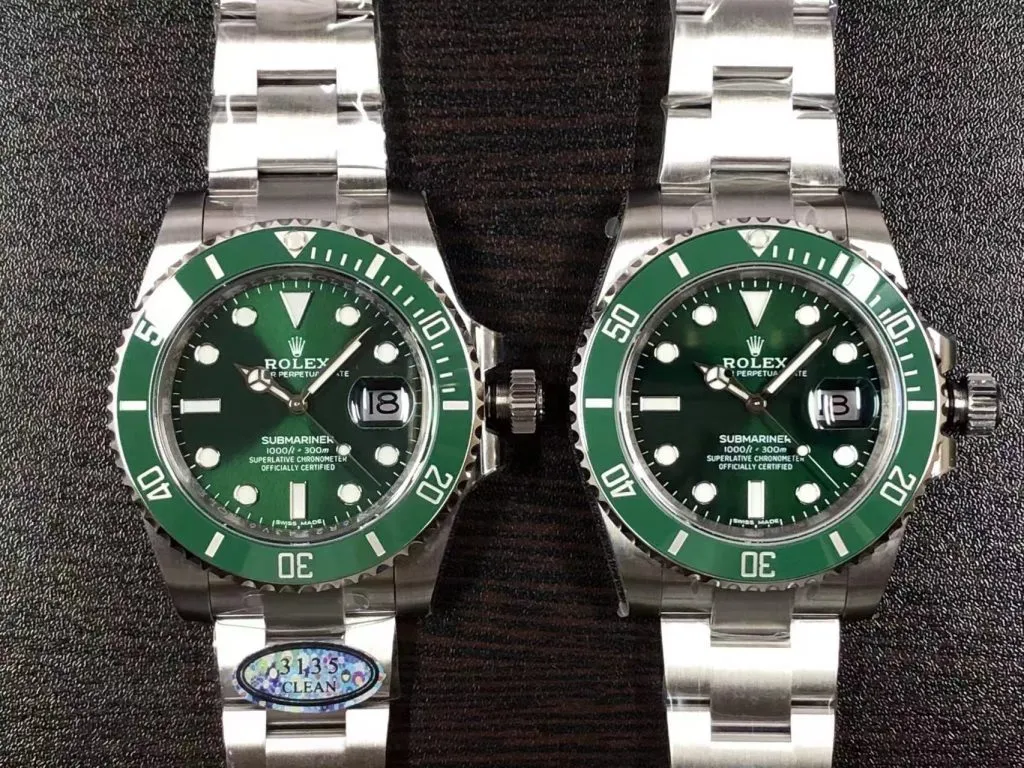
Submariner 126610LN
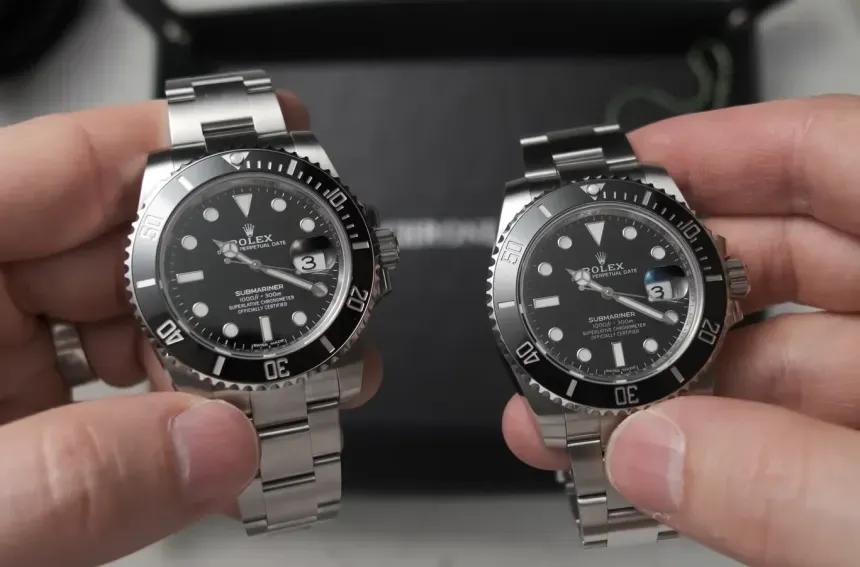
On genuine models, the Submariner shows extremely refined lug shaping, consistent crown guard geometry, and precise bracelet integration.
High-end superclones replicate these proportions closely, but subtle differences in case thickness and edge finishing can still be observed under magnification.
Cyclops alignment and magnification consistency remain one of the most noticeable differences between genuine and replica versions.
GMT-Master II 126710BLRO (Pepsi)
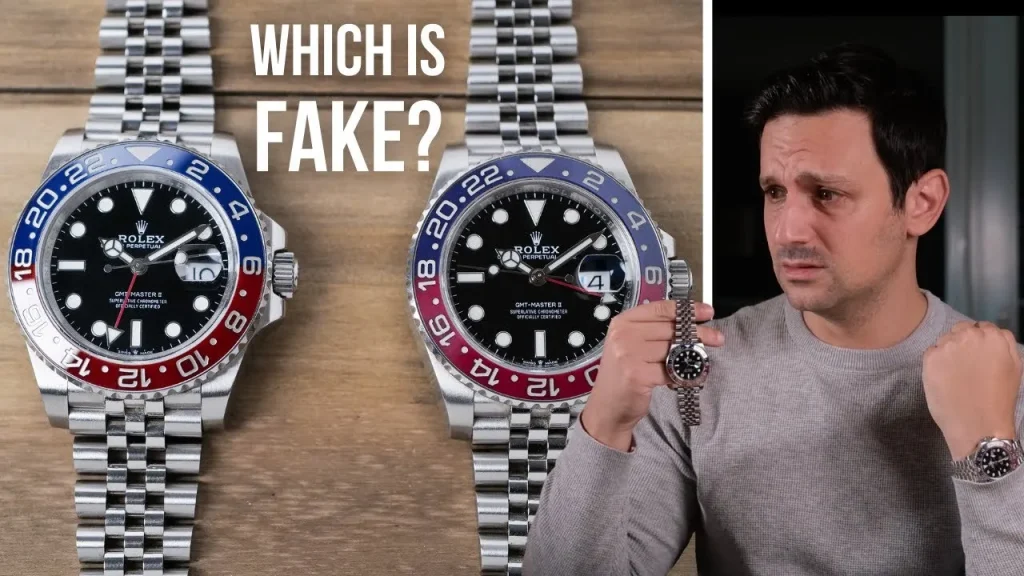
The ceramic Pepsi bezel remains one of the most technically demanding elements to replicate accurately.
Genuine Rolex inserts feature perfectly balanced red-to-blue transitions with deep ceramic saturation. In 2026 superclones, color accuracy has improved significantly, but slight variation in saturation or gradient smoothness may still be visible depending on lighting.
Dial text alignment and hand stack precision are also areas where small differences persist.
Cosmograph Daytona 116500LN
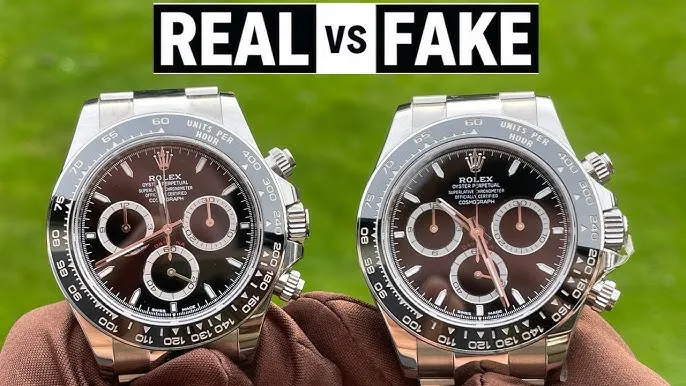
The Daytona is often considered one of the most closely replicated Rolex models visually.
Superclones achieve strong dial symmetry and chronograph layout accuracy, especially in panda dial configurations. However, differences remain in:
- Subdial depth perception
- Pusher tactile feedback
- Engraving sharpness under magnification
- Movement finishing consistency
At a glance, the visual similarity is extremely high, but mechanical refinement still differs.
What Still Separates Genuine Rolex from Superclones
Even in 2026, several core differences remain consistent:
- Movement finishing and long-term reliability
- Micro-level engraving precision
- Crystal optics and magnification accuracy
- Weight distribution engineering
- Bracelet tolerances and clasp refinement
- Official Rolex service and certification network
These factors are difficult to replicate fully due to manufacturing scale and proprietary Swiss engineering standards.
Red Flags in Superclone Evaluation
Common indicators of lower-quality replicas include:
- Misaligned rehaut engraving
- Inconsistent lume brightness or color
- Off-center cyclops magnification
- Loose bezel rotation or uneven clicks
- Weak or shallow caseback engravings
- Incorrect weight distribution
- Poor bracelet finishing or sharp edges
Lighting and macro inspection are often necessary to identify these issues accurately.
Market Context and Pricing
In 2026, high-tier superclones typically range from $400 to $1,200, depending on model complexity, factory, and movement type.
By comparison, genuine Rolex watches generally start at several thousand dollars and can exceed tens of thousands depending on material and model.
The key difference is not only price, but also long-term value retention, authenticity, and service infrastructure.
FAQ
What is a superclone Rolex in 2026?
A superclone Rolex is a high-end replica designed to closely match genuine Rolex watches in appearance and basic function, using upgraded materials and cloned movements.
How close are superclones to genuine Rolex watches?
Visually, many 2026 superclones achieve a high degree of similarity at arm’s length. However, differences become more visible under close inspection or technical testing.
What movements do superclones use?
Most use cloned versions of Rolex calibers such as 3135, 3235, or 4130-style chronograph movements, offering reasonable performance but lacking Rolex-grade certification.
Are superclones legal?
They are generally considered counterfeit products and may be restricted or illegal depending on jurisdiction, especially for import or resale.
Which factories are most recognized in 2026?
VS Factory and Clean Factory are frequently referenced in enthusiast discussions for producing higher-tier replica models with improved finishing and movement consistency.
Conclusion
By 2026, superclone Rolex watches have reached a level where visual differences from genuine models are increasingly subtle in everyday wear. Models like the Submariner, GMT-Master II, and Daytona can appear highly convincing under normal conditions.
However, fundamental differences remain in movement engineering, finishing precision, long-term durability, and official service infrastructure. A genuine Rolex represents certified Swiss horology backed by decades of development, while superclones remain visual and functional approximations without institutional support.
Ultimately, the distinction between the two lies not only in appearance, but in engineering depth, authenticity, and long-term ownership value.